

Work Package 5
Indicateur d'intensification durable
Objectif
L'objectif principal de ce module de travail est d'identifier des pratiques innovantes, orientées vers l'intensification durable (ID) de systèmes agricoles représentatifs de différentes zones agro-climatiques d'Afrique de l'Est et de l'Ouest. Cet objectif sera atteint grâce au développement d'un cadre opérationnel basé sur des indicateurs SI s'appuyant sur des cadres déjà proposés mais mis en œuvre et améliorés tout au long du projet avec l'intégration de connaissances expertes et profanes, de mesures sur le terrain et d'approches de modélisation.
Partenaires
Partners involved: UNISS, ACRA, IRD, UNB, INERA, UNIMAK, CSIR-SARI, KDC, KALRO, UoN, NM-AIST, TARI, HU, JU, ICRAF
WP Leader: UNISS
WP Co-Leader: University of Cranfield
Tâches
5.1
Identification d'indicateurs d'intensification durable
Une liste préliminaire d'indicateurs à différentes échelles et pour différents domaines sera identifiée aux premiers stades du projet grâce à une étude documentaire et en mobilisant les connaissances spécialisées des partenaires du projet. La liste préliminaire des indicateurs sera révisée tout au long du projet à travers un processus itératif qui impliquera tous les autres WP
5.2
Développement d'un indicateur composite d'intensification durable
Dans cette tâche, les indicateurs ID seront agrégés selon la procédure proposée par Metzger et al. en 2006 pour évaluer la vulnérabilité des services écosystémiques au changement d'affectation des terres. Cette procédure vise à agréger une liste d'indicateurs en plusieurs niveaux d'agrégation (déterminants et composants) jusqu'à un indicateur unique par une approche de logique floue
Activités réalisées
Dans le cadre du WP5, un indicateur composite d'intensification durable (SI) a été développé à l'aide d'une approche basée sur la logique floue, permettant l'intégration de multiples indicateurs dans cinq domaines de durabilité : productif, environnemental, économique, social et humain. Cette méthode tient compte de l'incertitude et permet une pondération spécifique au contexte de chaque indicateur. Les résultats montrent une performance globale solide des technologies analysées dans les cinq domaines de l'IS, tout en soulignant la nécessité de solutions spécifiques au contexte. Les pratiques et les technologies étant adaptées aux conditions locales, les comparaisons entre pays ne sont pas applicables.
Espèces végétales négligées et sous-utilisées (NUS)

Espèces négligées et sous-utilisées : culture intercalaire du fonio (NUS) et du niébé au Burkina Faso

Espèces négligées et sous-utilisées : culture intercalaire du fonio (NUS) et du niébé au Burkina Faso

Engrais organique
Fertilisation organique : utilisation combinée d'engrais organiques et inorganiques (niveau d'intensification élevé) et utilisation exclusive d'engrais organiques (niveau d'intensification faible) pour la culture du sorgho au Burkina Faso.

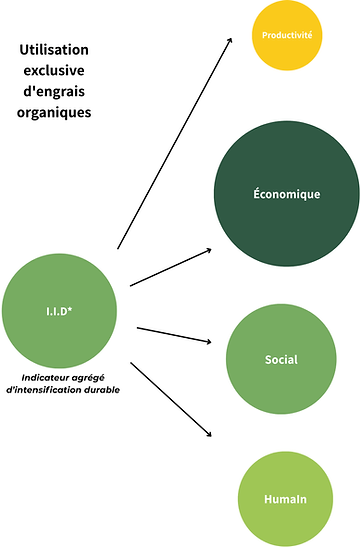
Fertilisation organique : l’utilisation d’engrais organiques et inorganiques combinés (niveau d’intensification élevé) et l’utilisation d’engrais uniquement organiques (niveau d’intensification faible) pour le maïs au Ghana.


Fertilisation organique : l’utilisation d’engrais organiques et inorganiques combinés (niveau d’intensification élevé) et l’utilisation d’engrais uniquement organiques (niveau d’intensification faible) pour le maïs au Kenya.


Fertilisation organique : l’utilisation d’engrais organiques et inorganiques combinés (niveau d’intensification élevé) et l’utilisation d’engrais uniquement organiques (niveau d’intensification faible) pour le maïs en Sierra Leone.


Fertilisation organique : l’utilisation d’engrais organiques et inorganiques combinés (niveau d’intensification élevé) et l’utilisation d’engrais uniquement organiques (niveau d’intensification faible) pour le haricot commun en Tanzanie.


Gestion durable de l'eau

Récupération traditionnelle de l'eau : fosses Zai
au Burkina Faso

Collecte traditionnelle de l'eau : digues en pierre au Ghana.

Récupération des connaissances traditionnelles en matière de protection des végétaux
BIOPESTICIDES : Extrait de Cassia nigricans* pour le niébé au Burkina Faso

BIOPESTICIDES : Extrait de neem* pour le niébé au Burkina Faso.

BIOPESTICIDES : Extrait de neem* pour le maïs au Ghana.

BIOPESTICIDES : Tephrosia vogelii + neem + extrait de Capsicum sp.* pour le haricot commun en Tanzanie

Aflasafe pour le maïs au Ghana

Aflasafe pour le millet des doigts au Kenya
